
The Complete Guide to the RÉSO (Montreal Underground City)
Introduction
Montreal is famous for its winters — and for solving them.
Beneath downtown lies RÉSO, Montreal’s Underground City: a vast network of tunnels, metro stations, shopping centers, office towers, hotels, universities, and cultural venues connected indoors.
Stretching for over 30 kilometers (20+ miles) of pedestrian pathways, it’s one of the largest underground urban networks in the world.
This guide explains:
- What RÉSO really is
- How big it is
- Where to enter
- What you can find inside
- When it’s open
- How to navigate it
- Whether it’s worth visiting
What Is Montreal’s Underground City?
The Underground City — officially branded as RÉSO — is not a single tunnel system.
It is a connected network of buildings in downtown Montreal linked by interior corridors, shopping malls, metro stations, and underground passageways.
It connects:
- Metro stations
- Office towers
- Shopping malls
- Hotels
- Universities
- Museums
- Event venues
Rather than walking outside in winter, pedestrians move through heated indoor corridors.
How Big Is the Montreal Underground City?
- 30+ km (20+ miles) of pedestrian walkways
- 1,600+ shops and businesses
- 200+ restaurants
- 10 metro stations connected
- Hundreds of thousands of daily users in winter
It spans much of downtown Montreal, from the financial district to the Quartier des Spectacles.
Why Was It Built?
The underground network began in the 1960s during the construction of Place Ville Marie and the Montreal Metro.
Key developments:
- Expansion during the 1960s–70s metro construction
- Growth during the period surrounding Expo 67
- Continued expansion via private real estate development
Montreal’s harsh winters made indoor connectivity economically and socially attractive.
Major Hubs Inside RÉSO
Some of the most important connected complexes include:
- Place Ville Marie
- Complexe Desjardins
- Centre Eaton de Montréal
- Place Montréal Trust
- Bell Centre
Each functions as a mini-hub within the larger network.
How to Enter the Underground City
You can access RÉSO through:
- Metro stations
- Shopping mall entrances
- Hotel lobbies
- Office towers
- Street-level staircases in downtown buildings
Major metro access points include:
- McGill Station
- Bonaventure Station
- Square-Victoria–OACI Station
Is Montreal Underground City Free?
Yes.
There is no entry fee. It is a public pedestrian network connecting private and public buildings.
However:
- Individual businesses follow their own hours.
- Some corridors close at night.
What Are the Hours?
There are no unified hours.
Typical pattern:
- Shopping areas: ~10 AM – 6/9 PM
- Office corridors: business hours
- Metro-connected corridors: aligned with metro hours
Winter evenings and Sundays may have limited access in certain sections.
What Can You Do Inside?
Visitors can:
- Shop
- Eat
- Attend concerts or hockey games
- Visit art installations
- Access universities
- Stay at connected hotels
- Avoid snowstorms
Event access is especially useful for games at the Bell Centre or winter festivals.
Is It Worth Visiting as a Tourist?
It depends.
If you:
- Visit in winter → absolutely useful
- Stay in a connected hotel → extremely convenient
- Enjoy urban infrastructure → fascinating
If you’re visiting in summer and prefer outdoor exploration, it’s less essential.
Common Misconceptions
❌ It is not one giant tunnel.
❌ You cannot access the entire 30 km continuously without entering buildings.
❌ It is not fully open 24/7.
Montreal Underground Map
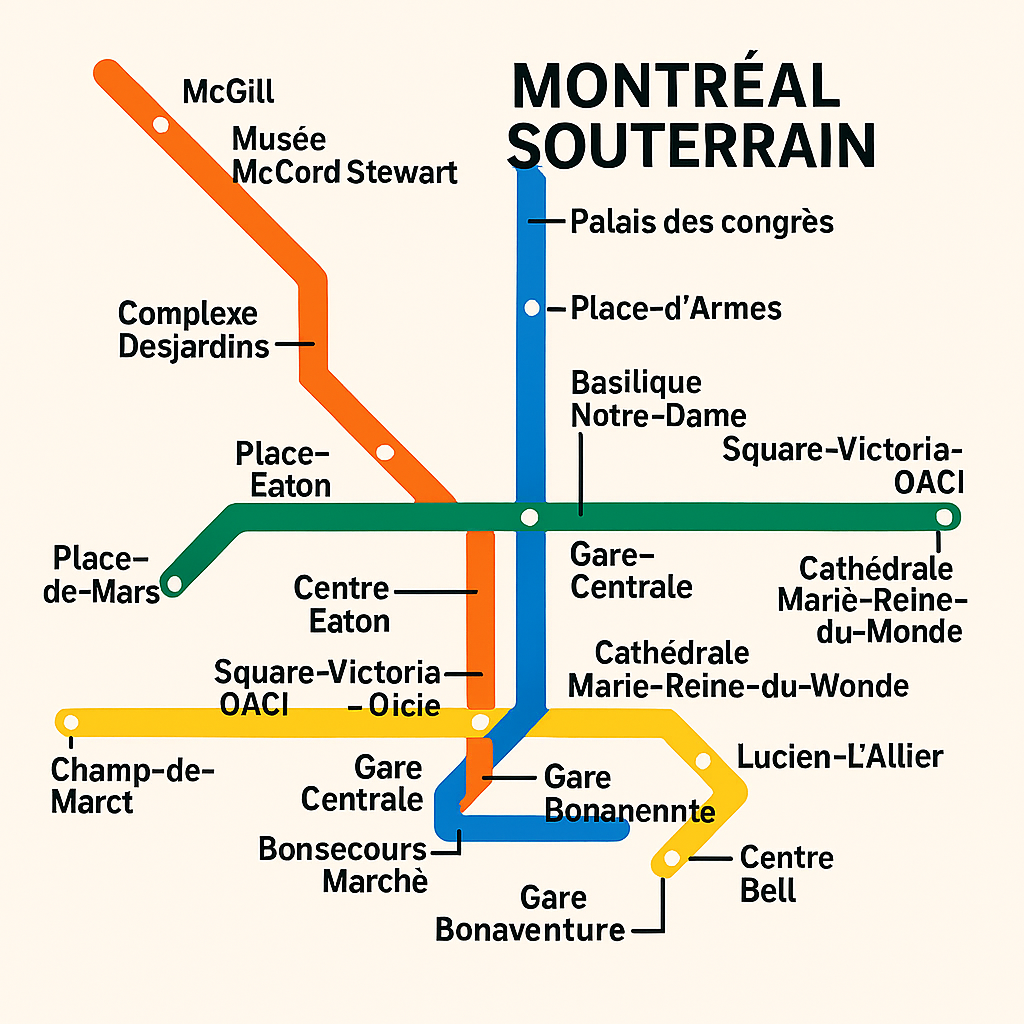
Map of Montréal’s Underground City, highlighting must-see attractions at key metro stations.
FAQ Section
How long does it take to walk the Montreal Underground City?
Walking the full connected network would take several hours, but most visitors use sections between 5–20 minutes at a time.
Is it the largest underground city in the world?
It is often cited as one of the largest, though comparisons vary depending on measurement criteria.
Can you live in the Montreal Underground City?
No. It is a pedestrian and commercial network, not a residential underground settlement.
 -
- -
- -
- -
- -
-